Every business runs on the internet now. The 12-person accounting firm. The 40-person logistics company. The e-commerce startup that just closed its seed round. They all store customer data, process payments, handle sensitive documents, and depend on cloud tools to operate.
And every one of them is a target.
43% of all cyberattacks target small businesses. Not because attackers don't know where the big money is — but because small businesses are the easiest to break into. No firewalls. No monitoring. No security team. Most don't even know where to start.
We built SecurityPulse because we believe this is fundamentally broken — and fixable.
Three Eras of Cybersecurity (and Why None of Them Work for You)
The first era of cybersecurity was about walls. Firewalls, VPNs, perimeter controls. The assumption was simple: keep the bad guys out and you're safe. That worked when your "office" was a physical building with a server in the closet.
The second era was about watchtowers. SIEMs, detection rules, alert pipelines. When walls stopped being enough, the industry built monitoring systems. The problem? Watchtowers generate thousands of alerts. Someone has to look at them. For a Fortune 500, that someone is a SOC team of 30 analysts making six figures each. For a small business, that someone is... nobody.
The third era — the one we're in now — is supposed to be about AI-native security. Platforms that don't just detect threats but understand your environment, reason about what's normal, and act autonomously. That's the promise, anyway.
But here's the problem: every company building in this era is building for enterprises. $100K+ annual contracts. Six-month deployments. Dedicated customer success managers. Integration teams.
Nobody is building it for you.
Not for the business with 15 employees and no CISO. Not for the startup whose "security strategy" is hoping nothing bad happens. Not for the company that knows it needs to get SOC 2 compliant but doesn't know where to start.
That's the gap SecurityPulse fills.
The Gap Between Having Data and Having Protection
There's a subtle but critical difference between knowing and understanding.
Most security tools are very good at generating data. Your antivirus knows it blocked a file. Your email provider knows it flagged a phishing attempt. Your cloud platform knows someone logged in from a new location.
But none of them talk to each other. None of them understand context. Was that login suspicious because the user was on vacation, or routine because they travel every Tuesday? Was that blocked file a real threat or a false positive? Is that phishing email part of a broader campaign targeting your industry?
Small businesses end up in one of two situations:
- No protection at all. They know they should do something, but the complexity and cost are paralyzing. So they do nothing and hope for the best.
- Fragmented protection. They buy an antivirus here, a backup tool there, maybe get a compliance consultant once a year. None of it is connected. Gaps everywhere.
Both end the same way: when something goes wrong, nobody sees it until the damage is done.
Our Thesis: Deploy Fast. Manage Autonomously.
We asked a simple question: What if a small business could have the same security coverage as an enterprise — deployed in minutes, not months — and managed by AI instead of a team of analysts?
That question became two products.
RunWay: Deploy the Stack
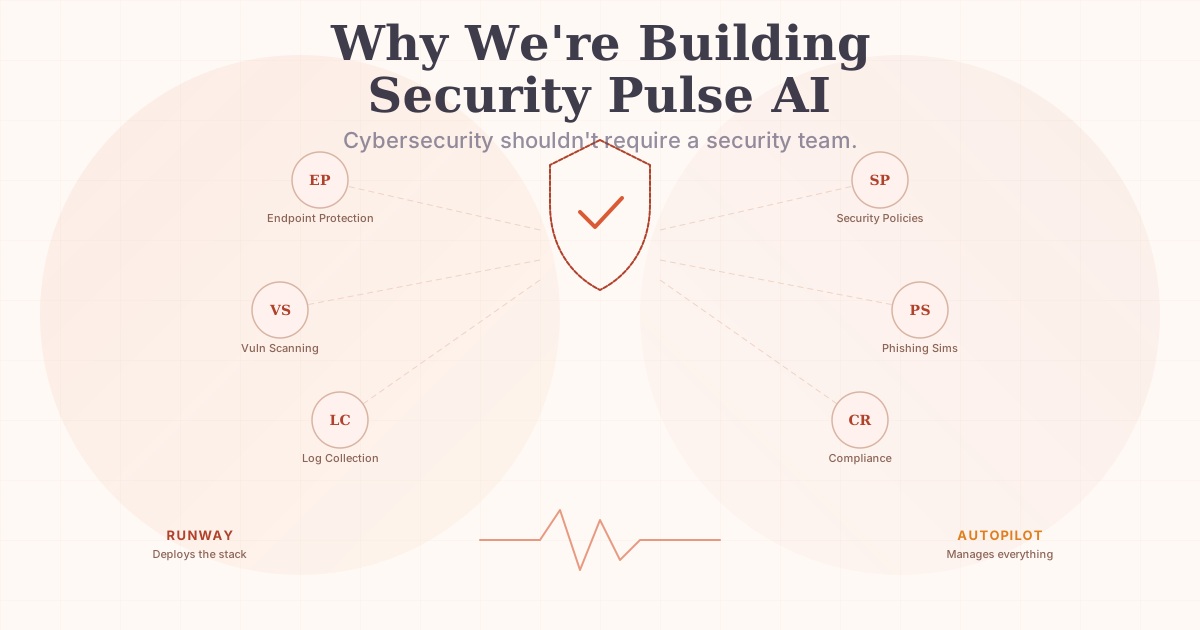
RunWay is how your security stack gets deployed. Each solution is an agent — endpoint protection, vulnerability scanning, log collection, security policies, phishing simulations, compliance reporting. You click install. It goes live. It starts doing its job.
No consultants. No configuration marathon. No "let's schedule a kickoff call and circle back in three weeks." Minutes, not months.
The idea is simple but the execution matters: every agent is pre-configured with sensible defaults, tuned for small and mid-sized businesses, and designed to work together as a system, not a collection of disconnected tools.
Autopilot: Manage Everything
Deploying tools is the easy part. Managing them is where most businesses fail.
Autopilot is your AI SOC — your security operations center. Once RunWay deploys the agents, Autopilot ingests all the data they generate. It correlates signals across every source. It triages alerts so you don't have to stare at a dashboard wondering what's important. It monitors continuously. It collects compliance evidence automatically.
The agents keep doing their jobs. Autopilot manages them.
And here's the part we're most excited about: you can ask Autopilot anything in plain language.
- "Are we PDPA compliant?" — Get a full compliance posture report with evidence gaps highlighted.
- "What happened this week?" — Get a weekly security summary: threats blocked, alerts triaged, vulnerabilities found.
- "Generate a report for our client." — Get a client-ready security report with posture score and incident history.
No query language. No dashboards to decipher. Just ask.
Why Now?
Three things have converged to make this possible:
- AI is finally good enough to reason about security data. Not just pattern matching — actual reasoning. Understanding context, correlating signals, making judgments about severity and relevance. This wasn't possible two years ago.
- The threat landscape has shifted. Attackers are using AI too. Phishing emails are better. Automated attacks are faster. The window between "we got breached" and "the damage is done" has collapsed from days to hours. You need security that acts at machine speed.
- Regulatory pressure is real. PDPA in Singapore. CSA Cyber Essentials. SOC 2 expectations from enterprise buyers. ISO 27001. These aren't optional anymore — they're table stakes for doing business. And the compliance burden falls heaviest on the smallest companies that can least afford it. See our Complete 2026 Cybersecurity Compliance Guide for a full breakdown of what each framework requires and costs.
What We Believe
We believe cybersecurity shouldn't require a security team. We believe a 15-person company deserves the same protection as a 15,000-person company. We believe deployment should take minutes, not months. We believe compliance shouldn't mean hiring a consultant who hands you a 200-page PDF. We believe you should be able to ask a plain-language question and get a real answer.
RunWay deploys the stack. Autopilot manages everything. You focus on your business.
That's what we're building. That's why we're building it.
If this resonates, we'd love to show you how it works. Book a free consultation and we'll walk you through what RunWay deploys and how Autopilot manages it for your specific business.
Related reading
- About Security Pulse — the team and mission behind the platform.
- Product overview — how RunWay and Autopilot fit together.
- Cybersecurity for small businesses — the audience we built this for.
- Complete 2026 Cybersecurity Compliance Guide — frameworks, costs, and how continuous compliance works.
- What is continuous compliance monitoring? — the engine behind Autopilot.
- Partner with us — work with Security Pulse as an MSP, MSSP, or vCISO.